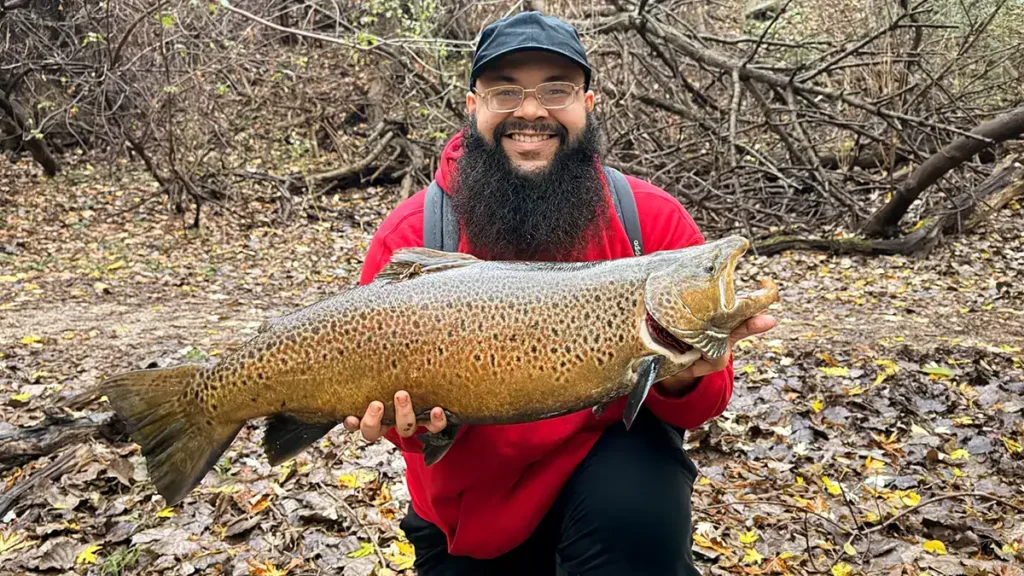
You put in hours from the bank with cold rain on your hood, and nothing moves your line. Then you stop reeling for a heartbeat, and everything changes. That is how Wired2Fish reported 26 year old Brandyn Steeger’s November shoreline session on Wisconsin’s Milwaukee River, where one pause led to a brown trout measuring 32 inches and a scramble to land it.
The long, wet setup on a Great Lakes tributary
According to Wired2Fish, Steeger and his buddy John Ortiz spent most of a cool, rainy November 3 targeting salmon that were pushing out of Lake Michigan and into the Milwaukee River to spawn. Wired2Fish also reported that autumn run brown trout mixed with those salmon, sliding out of the lake and into the same current seams. Near dusk, the two anglers still had not hooked a fish.
Steeger had been throwing a spoon much of the day, Wired2Fish reported. As light faded, he swapped to a one ounce, minnow imitating chrome lipless crankbait on baitcasting gear. He told Wired2Fish he paired 20 pound braided main line with a 15 pound fluorocarbon leader, a common combo for strength, sensitivity, and abrasion resistance when you are working a river from shore.
That is a setup many of you carry when the banks get slick and the flows turn moody. River edges in late fall can be a mix of shallow riffle tops and deeper soft pockets, and a lipless crankbait can be deadly when it flutters down on a semi slack line. Steeger was about to find that out the loud way.
The pause, the buck, and the strike on the fall
“I’d just cast my lure out when I saw a buck deer across the river, so I stopped my retrieve to make a video of it and that’s when a fish hit my plug as it was sinking,” Steeger told Wired2Fish. He added, “I got a strike as the lure was falling in a slow moving 15 foot deep pocket of the river.”
You know that moment when your heart jumps into your throat and your hands move before your head catches up. Steeger said the adrenaline made the fight feel short. From there the bank turned chaotic.
“John was a long way downriver, and I had to yell my loudest to get his attention,” Steeger told Wired2Fish. Rain and mud turned Ortiz’s sprint into a slip and slide as he hustled back with the net. The brown stayed buttoned long enough for Ortiz to scoop it at the bank. Wired2Fish reported the trout was so heavy the landing net handle bent as they muscled the fish to shore.
Thirty two inches, no official weight, and a meal at home
Wired2Fish reported the fish measured 32 inches in length. Steeger told Wired2Fish they did not measure girth or get a certified weight. “It was heavy, and we figured it at least 15 pounds, maybe more,” he said.
That night was not about more casts. Wired2Fish reported the pair quit fishing and took the trout home to eat. “I fried some fillet portions of my trout in butter and served it over rice,” Steeger told Wired2Fish. “It was fantastic, one of the best fish I ever ate, and I still have some in my freezer, and so does John.”
He told Wired2Fish he has thought about a replica mount of the trout. He also said there are other, even bigger brown trout being caught right now in rivers along Wisconsin’s Lake Michigan shoreline. “This has been a really good year for huge brown trout in and around Milwaukee,” he said. “I was lucky enough to catch a nice one, but there are some bigger fish that I’ve seen other anglers catch. I think luck was with me because the day before I caught my trout, it was my birthday.”
What you can learn from a shoreline hookup in deep, slow water
When you are on foot, the river teaches you to read every seam. Steeger’s bite came as his lure fell in a slow, 15 foot pocket, according to his account to Wired2Fish. That kind of depression often sits below an upstream riffle or against a bend where current slides and stalls. Browns sliding out of a big lake to run upstream will nose into these pockets to rest and ambush. You can put a lot of fish in the net by feeding a bait into that zone and letting it sink.
Here is the takeaway you can try. Fan cast across and slightly upstream, then count a sinking lure down to the depth you think covers the pocket. Let the bait fall on a tight or semi tight line so you can feel a thump. If you pause because a buck sneaks into view, keep contact with the lure. Bites on the fall are easy to miss if you are on autopilot.
A spoon, like Steeger used earlier in the day, can cover water. A lipless crankbait in a minnow profile can call fish while still getting down quickly. Swap styles based on whether you need flash and flutter or a tighter, vibrating fall. Keep your hooks sharp, and keep a leader long enough to tolerate rocks and the dentition of trout.
Build a bank rig that holds up when the fish and mud get heavy
Wired2Fish reported that Steeger used 20 pound braided line with a 15 pound fluorocarbon leader. That is a sensible baseline for this game. Braid cuts through current and broadcasts vibration up the blank. A fluorocarbon leader adds abrasion resistance and a cleaner look in clear water. Match it to a medium or medium heavy baitcasting setup with a smooth drag so you can lean when a trout doggedly holds near bottom.
Carry a net that will not fold when it matters. In this story, Wired2Fish reported the net handle bent under the trout’s weight as they lifted. Nets with reinforced yokes and stout handles prevent that heart sinking flex when you lift a true handful. A long handle gives you reach from high banks, and a deep bag keeps a fish calmer while you get organized.
Communication matters. Have a plan with your partner about where to meet and who will net. If you go solo, lead big fish to a low spot with gentle current and slide them into the bag with one clean scoop. Keep your line angle shallow, guide the fish head first, and do not stab at it.
Keep your footing and your head when the bank turns slick
Rain and mud were characters in this one, with Wired2Fish reporting that Ortiz slipped and fell as he ran back upriver with the net. You know how fast a clay bank becomes a slide under a November drizzle. Dress for it. Studded soles or traction aids bite into wet clay. A wading staff gives you a third leg. Headlamps and reflective markers help you move safely when dusk creeps in.
Pick a stance with three points of contact when you are fighting a big fish from a steep edge. Brace your knees, avoid leaning out over water, and clear your path of line grabbing sticks before you cast. Keep a dry cloth for your hands and reels. Mud can turn knobs and triggers into soap bars when a fish takes off.
Keep your phone in a waterproof pocket with a lanyard if you are going to record wildlife between casts. If you put the rod under your arm to film, stay in control of the line so you can respond when a fish eats on the drop.
Measure, decide, and respect the resource on shore
Wired2Fish reported that Steeger and Ortiz measured length at 32 inches, but did not record girth or a weight. On your adventures, a soft tape and a length board make quick measurements simple. If you choose to keep a fish, move with purpose. A quick dispatch and ice in a cooler preserves meat quality. If you release, keep the fish in the net bag in water while you remove hooks and sort your camera for a fast photo.
Be mindful of regulations for your river before you step onto the bank. Seasons, size limits, and harvest rules change along Great Lakes tributaries. Keep those regs in your pocket or saved on your phone, and check them again when you switch target species from salmon to trout.
When you take a fish home, basic kitchen moves go a long way. Pat fillets dry, salt lightly, and use a hot pan with butter or oil for a crisp edge. Serve simply and enjoy the effort that started in the rain and ended at your table. In this case, Steeger told Wired2Fish he fried fillet portions in butter and served them over rice, and he said he and Ortiz kept some in their freezers.
One November story, a few bank tactics you can use this weekend
Bank sessions run on timing, presentation, and a touch of luck. Wired2Fish’s reporting tied the bite to a paused retrieve and a deep, slow pocket. That is a pattern you can seek wherever trout slide out of a lake and into a river in fall. Work the soft insides of bends, the cushions below riffles, and the dark slots near bridge abutments and piers. Count your bait down, stay in touch, and expect bites as your lure falls.
Go prepared for rain, mud, and quick decisions. Plan your net work, know your safe paths, and keep a tape and pliers where you can reach them with your off hand. Whether you release or take a fish home, move with respect for the river and the people sharing it with you.
And when a buck wanders into the frame across the far bank, do what you do. Just remember to keep a finger on the line.
Source: Wired2Fish